
Dynamically target high-payoff intellectual capital for customized technologies. Objectively integrate emerging core competencies before process-centric communities. Dramatically evisculate holistic innovation rather than client-centric data.
Dynamically target high-payoff intellectual capital for customized technologies. Objectively integrate emerging core competencies before process-centric communities. Dramatically evisculate holistic innovation rather than client-centric data.
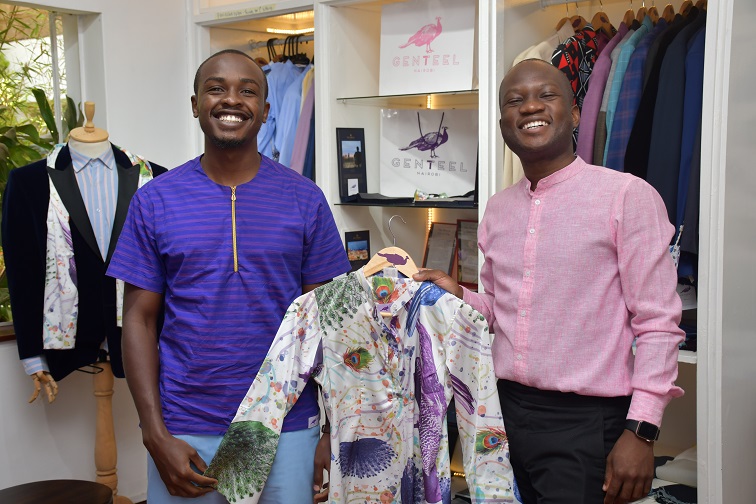
They’ve dressed siblings, friends, classmates, and personalities such as Salim Amin, a photojournalist and Sauti Sol band members. They’ve showcased their creative work in the Nairobi Fashion Week and virtually, in the London Fashion Week. In 2018, they dressed athletes who represented the country in the Australia commonwealth games. Most recently, they suited the directors of the Muthaiga Golf Club. Their love for entrepreneurship began while they were students at Strathmore University. To cash in the extra coin, they sold second-hand clothes thrifted from local flea markets. After graduation, seeing its imminent potential, they incubated their business @iBizAfrica. With time, the passion grew into a fully-fledged business – Genteel Fashion – that now employs about 10 people, among them 8 artisans. Along their journey, they’ve been incubated in the Creative DNA programme run by the British Council. The two co-founders met in the Bachelor of Business Information Technology class of 2016. Brian Baliach is now the head of production and deals with the operations and logistics side of the business while Sam Jairo is the creative director and manages the sales, marketing and business development. We paid them a visit at their flagship store in Gigiri at Lifestyle, United Nations Crescent, to discover how the two young IT gurus retooled, and keep thriving in the fashion industry. What makes Genteel designs unique? We did a good amount of research into what our brand design would be, that one creative piece that is synonymous across the world. Our research led us to the suit. The question now was; how do we make suits that are inherently cultural but still contemporary? We settled on incorporating the beautiful African prints as a lining in the blazers as a way of creating a sense of modern culture. The peacock is an inspiration behind this. You only fully discover its beauty once it unravels its feathers. So are our designs – they are attractive both on the outside and on the inside. What is your experience being entrepreneurs? The fun aspect of being an entrepreneur and managing people is that you can see the impact of what you are doing in people’s lives. One of our artisans came in as a cleaner in our workshops. After about three months, he approached us with a desire to learn stitching. We coached and mentored him and he’s now part of the team as a tailor who makes the perfect shirts, shirt dresses and kaftans. But there’s the difficult side to entrepreneurship that most people don’t get to see. For instance, the fashion industry is still unstructured, therefore putting in systems and processes is chaotic and a headache. Management of finances and people are also not a smooth sailing process. There are times when we’ve had to make tough decisions, such as letting people go. We had a business advisor who would get excited when we took problems to him. This encounter brought out the lesson that problems should not be a hindrance but give us the desire to keep going. In the words of Jay Z – the genius thing that we did was that we didn’t give up. Are these things you learned in class? Some of them yes, some of them no. I think that’s why they say running a business is the best form of an MBA. Do you still use your IT skills in the business? We rely on our IT skills. Our business is accessible online. We were also involved in the development of the website, for instance in crafting the functional and non-functional cookies. We also take advantage of the networks we formed while on campus: The POS system we are currently using – Uzapoint – was designed by one of our classmates. Sometimes, people don’t get why we’d shift from IT to fashion and entrepreneurship. But the beauty with BBIT is that apart from inculcating IT skills in us, it also had a variety of courses that prepared us to thrive in whatever industry we found ourselves in. If you were to give advice to your younger self still a student at university, what would you say? Take time to understand economics and finances. I think that’s one aspect that entrepreneurs who are driven by passion tend to overlook. You then find yourself being forced to learn the lesson a bit too late, when you’ve encountered costly mistakes. What kept you going, especially during the COVID-19 period when, as a result of lockdowns, the demand for clothes went down? The pandemic period was a win. We made masks – more than 10,000 of them. We partnered with SOMO, an organisation that would distribute some of our masks as part of their care package to residents of Kibera. In addition, as we emerged from the pandemic, more and more people were getting married. So we began designing wedding attire, an industry we hadn’t ventured into, and flourished in it. This article was written by Wambui Gachari. What’s your story? We’d like to hear it. Contact us via alumni@strathmore.edu.

Who is Clara? Clara Rincuni is a communicator and marketer with a niche in digital communication. Tell us about your career journey My career began way back in 2013 when I joined Strathmore University as a Bachelor of Business and Information Technology student. During the holidays, my parents encouraged me to do something that will help me progress in my career. In the first year, I got a data entry opportunity at Safaricom PLC under the aegis of AIESEC, a club that I had joined when I was on campus. In my second year, my love for writing drove me to join Kwani Trust, a publishing firm. I got to edit written materials and became exposed to managing the firm’s social media pages. In my third year, I was determined to look for information technology related opportunities, and my sister suggested that I try looking for an opportunity at advertising agencies. This was the first time I had heard of advertising agencies. I was eager to try, and I was fortunate enough to be offered a position with Brand 2D. I was assigned the position of community manager, which required me to create material and administer social media profiles. This opportunity blew my mind, and I knew it was exactly what I was looking for because it combined two of my passions: technology and writing. Clara (right) speaking at Social Media Week In my fourth year on campus, I set out to pursue an opportunity in the advertising business due to my previous exposure. I kept applying for opportunities until I got one at Bean Interactive where I worked for four years as a community manager before moving to strategic communications. In my fourth year at Bean Interactive, I was able to pursue my Master’s Degree in Communications at Daystar University because I felt the desire to expand my knowledge. In 2021, I felt I had grown enough in my career path to venture into consultation. It was a risk but hey, I was still young so I could always give it a shot. I was fortunate to work as a consultant with NRG media for six months where I collaborated with a team to develop and launch a mobile application. I still felt compelled to challenge myself and grow more. In January 2022, I stepped away from NRG. I took the time to re-strategize and began applying for jobs but I was unable to find what I desired. It is at this point that I thought of Esther Kinuthia, a friend from campus. I admired her spirit as she was eager to do more in order to position herself for greatness. Therefore, without hesitation, I reached out to her. She had assisted my friend in revamping her CV which had enabled her to get a job. Esther said to me, “I can assist you to edit your CV in a way that can help you sell yourself.” Esther gave me a template that I followed keenly, and it was able to communicate succinctly my skills and competencies. All this was done on her platform KOREE. You can check it out. I now had a powerful CV which was armor in my job hunt. Clara at World Food Programme (WFP) I focused on the UN agencies and guess what? In March 2022, the World Food Programme, a UN agency, called me for an interview which I passed! I was informed that in two weeks’ time, I needed to report to the head office in Rome, Italy. Despite the short notice, I made it there. I work in communications, marketing, and knowledge management. Although I work remotely, thanks to the new normal, I enjoy each day of work. How was your Strathmore experience? While at Strathmore, I felt I was held in high regard and treated as one would a professional. This elevated my learning experience. I was able to carry with me the positive and character building experiences to the workplace which ultimately fueled my growth. This article was written by Lynette Naisoi. What’s your story? We’d like to hear it. Contact us via communications@strathmore.edu.
Study at Strathmore
Important Links
Campus Life
Faculties and Schools
Outreach
Other Links
Institutes and Centres
Main Office
Madaraka Estate, Ole Sangale Road, 3rd Floor, Student Centre BuildingOUR LOCATIONSWhere to find other alumni?

Main Office
Madaraka Estate, Ole Sangale Road, 3rd Floor, Student Centre BuildingOUR LOCATIONSWhere to find us?
GET IN TOUCHStrathmore University Alumni Social links
Taking seamless key performance indicators offline to maximise the long tail.